The Potential of WorldView Legion for the Safety and Security in Europe
- Zuzana Hajkova, Content Marketing Coordinator, EUSI
In the ever-evolving landscape of global security, satellite imagery has become an indispensable tool for governments, organisations, and businesses worldwide. Many of them are now learning about the new opportunities that the six recently launched Vantor WorldView Legion satellites bring: higher border security, improved maritime surveillance, faster reaction to developing events, and much more.
WorldView Legion capabilities
The WorldView Legion constellation was launched by Vantor (formerly Maxar) throughout 2024 and 2025, and consists of six Very High Resolution satellites which complement the company’s other four sensors: GeoEye-1, WorldView-1, WorldView-2 and WorldView-3. Users in Europe get access to these satellites through EUSI, who directly operates them from Europe’s most advanced ground station in Munich, Germany. When combined, the cutting-edge technology of the sensors and the ground station offers:
- Near Real Time Delivery (NRT) up to 15 minutes after collection
- Tasking up to 30 minutes before satellite pass
- 30 cm native resolution
- Revisit rate up to 15 times a day (depending on the location)
- Full daytime coverage within -45 and +45 degrees of latitude
- 8 spectral bands
Speed matters: NRT delivery up to 15 minutes after collection improves emergency response and border security
When an emergency occurs, every second counts. With the ability to deliver actionable imagery as fast as 15 minutes after collection, WorldView Legion downlinking to EUSI’s ground station enables rapid response to developing situations. For example, if a natural disaster hits, responders can have a complete picture of the damage, accurately guiding rescue efforts, within hours. This speed transforms how we tackle not only natural catastrophes but also persistent challenges like border security, allowing authorities to spot and respond to developing situations almost in real-time.
30 cm resolution and 8 spectral bands enable fast and detailed imagery analysis
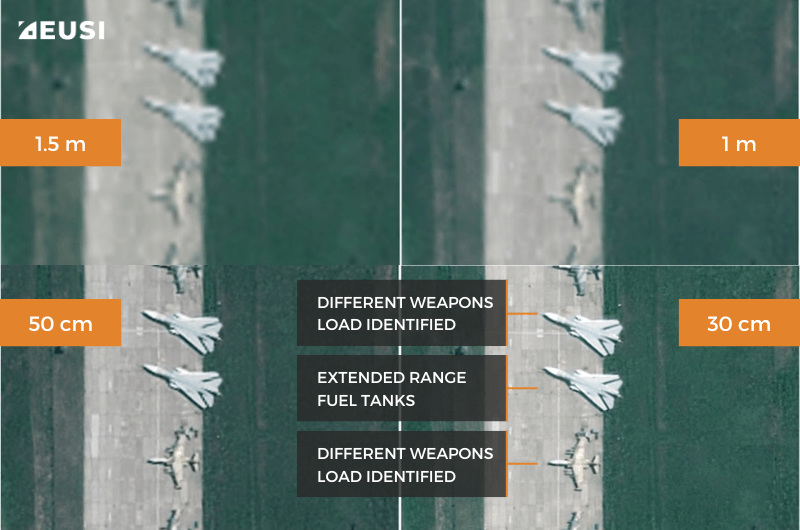
The Vantor constellation consists of 10 Very High Resolution satellites – seven of them, including the six WorldView Legion sensors, collect at 30 cm resolution with 8 spectral bands. By arranging these multispectral bands in various combinations, users can extract additional information that is invisible to the human eye, such as material composition or camouflage identification. Additionally, the very high resolution allows users to accurately identify equipment, monitor military assets and map the finest details of any critical situation.
In true 30 cm satellite imagery, you can identify details valuable for geospatial intelligence. Satellite imagery © 2026 Vantor Provided by European Space Imaging
Easy access to remote or restricted areas
Satellite imagery has the advantage of access to anywhere in the world. There is no border too remote or ocean too vast to capture enormous strips of imagery or pinpoint a narrow area of interest. This allows government and private users to monitor any situation without expensive and dangerous field work.
Stereo imagery from WorldView Legion for training simulations and mission planning
Stereo VHR satellite imagery is used to create 3D models of terrain, vegetation and structures, which can serve for training simulations and mission planning. These models, made by GAF AG from VHR stereoscopic images collected by EUSI, can be delivered 24 hours after collection.
The importance of choosing a trusted European data solutions provider
Selecting a European data provider ensures alignment with EU policies and security interests. EUSI independently operates the WorldView and WorldView Legion satellites over Europe with a local team at the ground station at the German Aerospace Center near Munich, Germany. They implement all relevant activities in the EU, in strict accordance with the EU Space Programme Regulation. 100% of management are EU citizens physically located in Munich, and 100% of contract decisions are made by the CEO, Adrian Zevenbergen.
Dynamic tasking: Last-minute orders, rapid delivery and customised parameters
In reaction to the demand of European users, EUSI has developed ATOM, a new advanced platform for direct tasking, archive ordering and project management. It gives users granular control over search filters, product parameters and tasking settings, provides real-time, accurate feasibility studies, and enables last-minute tasking up to 30 min before the satellite pass.
ATOM was built for complex, multi-user environments to support organisations of any scale, and provides 24/7/365 access, autonomy, transparency, security, and fine-grained control. The platform is currently released for selected users – contact us to request a demo.
Key takeaways
- Monitoring frequency: WorldView Legion significantly increases Vantor’s imaging capacity, enabling up to 15 revisits per day in some locations. This allows for more frequent monitoring of critical areas.
- Full daytime coverage: The mid-inclination orbits of some WorldView Legion satellites provide full daytime coverage within -45 and +45 degrees of latitude, enabling monitoring at various times throughout the day.
- Near Real-Time (NRT) monitoring: Upgrades to EUSI’s ground station allow for managing several parallel NRT orders and delivering actionable imagery as fast as 15 minutes after collection.
- Improved emergency response: Faster data collection and delivery enable quicker assessment of disaster-stricken areas or developing events.
- Enhanced border security and maritime surveillance: The ability to monitor critical areas throughout the day allows for rapid adaptation to developing situations.
- High-resolution imagery: WorldView Legion collects 30 cm resolution imagery, which provides detailed views for better analysis and decision-making.
- European source of data: EUSI independently operates the WorldView Legion satellites over Europe with a local team at their ground station near Munich, with all activities in strict accordance with the EU Space Programme Regulation.
- Dynamic tasking: A direct tasking platform ATOM, developed by EUSI, is available. It provides granular control over parameters, real-time feasibilities, and options for last-minute collection tasking.
Related Stories

Beginner’s Guide to Satellite Imagery: 10 Terms You Need to Know
Satellite imagery is an amazing but highly technical field with terms that might be hard to understand, especially for somebody with expertise in a completely different area. That’s why we are explaining the basics of satellite imagery in this article. What’s geolocational accuracy? What is the ideal off nadir angle? How can you see through clouds? Let’s dive right in.

Europe’s Green and Digital Transformations with 25 Years of VHR Satellite Archive Data
Planning Europe’s future without knowing its past is impossible. The European Green Deal, Horizon Europe, the EU Biodiversity Strategy for 2030 and other policies all demand one thing: evidence. Not just today’s data, but years of history that show how our cities, forests, and coastlines have changed.

AI Uses 15 cm Satellite Images to Cut Costs and Increase Scalability in Forest Management and Urban Forestry
Forest managers across Europe face an impossible task: monitor millions of hectares with shrinking budgets while meeting increasingly strict EU environmental targets. But with the rise of AI and satellite technology, they now have new solutions at their disposal – smarter, cheaper, and more scalable – to monitor forest health, automate tree inventories, and plan sustainable logging. In this article, we introduce one of these solutions: an AI forestry algorithm developed by Arboair using 15 cm satellite data from EUSI.

GEOSeries: Extracting Insights From High Resolution SAR Imagery for Time-Sensitive Analysis
In this webinar, industry experts and advanced users of Umbra SAR data showcase how they transform SAR imagery into actionable insights in real-world mapping, monitoring and intelligence applications. See how NV5 and Umbra leverage ENVI SAR Essentials for advanced processing with time-efficient results, converting analytics into valuable intelligence.