Large-scale Mapping: 7 Important Factors to Consider When Choosing Between Aerial and Satellite Sensors
- Zuzana Hajkova, Content Marketing Coordinator, EUSI
Member states and regional mapping agencies are often split on preferring aerial or satellite datasets. Which one is better? Users should carefully compare the two platforms to ensure the best data collection for their project. While a combined approach using satellite imagery to fill missing aerial data gaps can be effective, many organisations at both EU and national levels depend solely on VHR satellite data for successful wide area coverage. Here are 7 major factors to consider.
1. Weather conditions
Weather influences everyone: aerial surveys face challenges from wind and turbulence, which can significantly reduce flyable days, and satellites are impacted by cloud cover. But satellites can be more flexible in this regard.
How do satellites shoot around the clouds? European Space Imaging (EUSI) has a ground station in Munich, Germany, from where we operate Maxar satellites. Our Collection Planners combine forecasts with their own evaluations based on real-time data from weather satellites, with real-time weather being the primary decision driver in the majority of cases. They finalise the collection plan merely minutes before the contact with the sensor, which ensures that the cloud cover in the satellite images is minimal.
For example in autumn 2024, we completed a mapping project for a land surveying authority in Southern Germany when aircraft wasn’t able to fly due to unpredictable weather conditions. The whole area of interest – 6,588 km2 – was covered in 13 satellite images, and all of them were cloud-free.
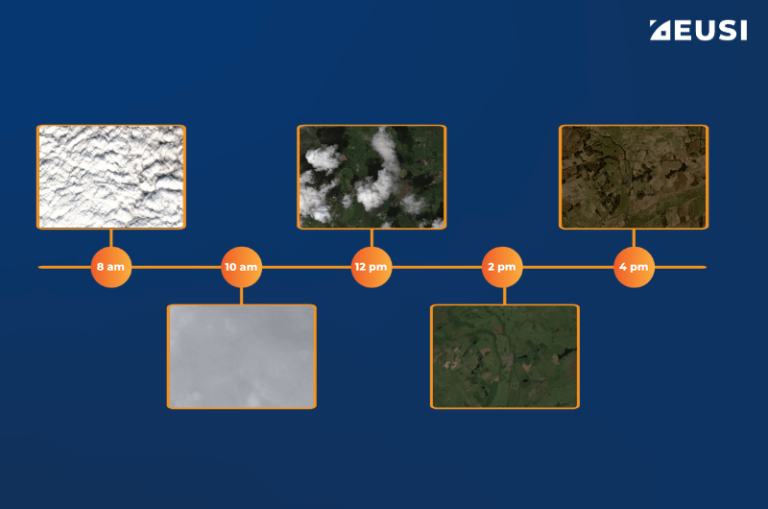
Moreover, in 2024 and 2025, Maxar launched new satellite sensors, giving EUSI an increased revisit rate over Europe. It’s now therefore even easier to optimise collections, mitigate weather conditions, and find cloud-free windows during different times of the day.
With the newly launched satellites – Maxar WorldView Legion – and the intra-day monitoring they bring, it’s possible to find cloud-free windows during different times of the day. This increases the success rate of satellite collections, and decreases the amount of cloud cover in satellite imagery.
2. Resolution
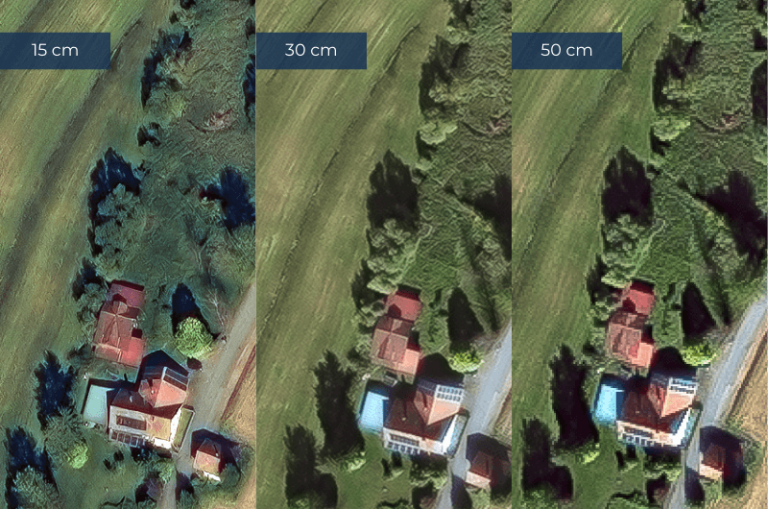
Aerial imagery offers higher resolution as a factor of altitude. However, typical LPIS or regional survey requirements (30–50 cm GSD) are well within the capabilities of some European satellite solution providers. Additionally, EUSI provides 15 cm HD imagery for large-scale mapping projects as well.
What is HD? Satellite images are collected at the native resolution of 30 cm and further enhanced by Maxar’s proprietary HD (High-Definition) technology. The technology intelligently increases the number of pixels through a complex mathematical model and results in 15 cm imagery. The same process can be applied to native 40–60 cm imagery to render a 30 cm HD image.
Whether you decide for 15 cm or 50 cm, native or HD, the very high resolution will allow you to digitalise land parcels, calculate surface, identify crops, monitor hedges, and much more. Satellite imagery © 2025 Maxar Technologies provided by European Space Imaging
3. Data homogeneity
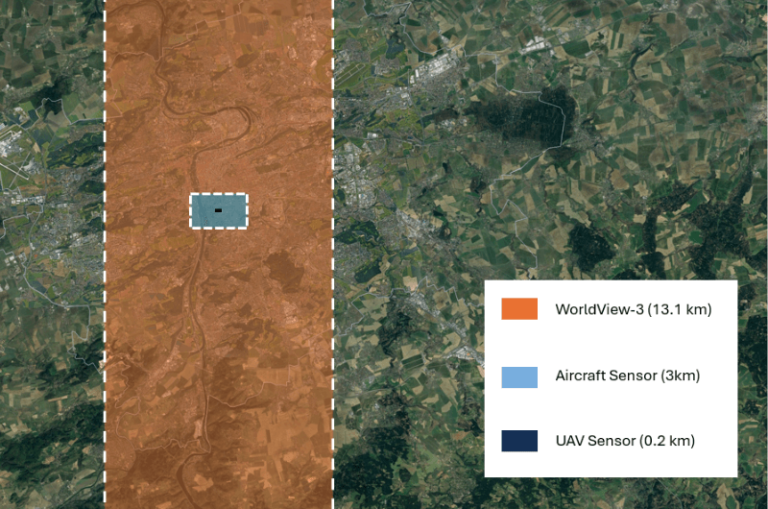
Satellites collect large, continuous strips of imagery in seconds. Thanks to that, the images have consistent shadow directions, colour balance, and crop conditions. Aerial imagery, collected as thousands of smaller frames over the course of several days, weeks or even months, can introduce variability across the same area.
Comparison of different sensors‘ image sizes.
4. Project efficiency
Satellites collect vast swaths of land in minutes, covering areas that aircraft would need days or weeks to map. Moreover, satellites continuously build archives of recent and historical imagery, which can sometimes supplement fresh tasking. EUSI collects all European urban areas at least once per year in 15 cm HD and tri-stereo, and 3+ million km2 are added to the archive every day.
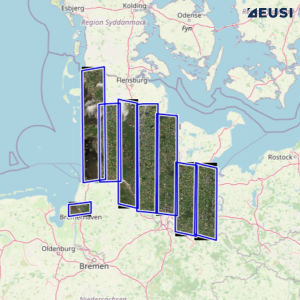
These are our collections in Northern Germany on 8 May 2024. The collection of these 8 stripes took approximately 2 minutes.
For instance, a land surveying authority from Hamburg approached us in September 2024 and requested archive imagery to update their LPIS. Their requirements were:
- collecting the whole area of the city-state (755 km2)
- 15 cm resolution
- cloud-free imagery
- 4 spectral bands
- colour-balanced mosaic
We used three suitable images from the archive, and collected one new image with the same parameters to cover the rest of the AOI. All four images had 0% cloud cover and a native resolution of 30 cm, which was further enhanced to 15 cm HD. We used this imagery to create the final product – 15 cm Dynamic Basemap –, and delivered it already one week after receiving the order.
5. Multispectral and stereo capabilities
Both airborne and satellite sensors can offer 4 or 8-band multispectral imagery as well as stereo collections. The WorldView satellites collect 8 VNIR bands standard unlike other satellite or aerial sensors. Satellite tri-stereo collections, however, are better suited for key regions and urban areas.
6. Restricted access
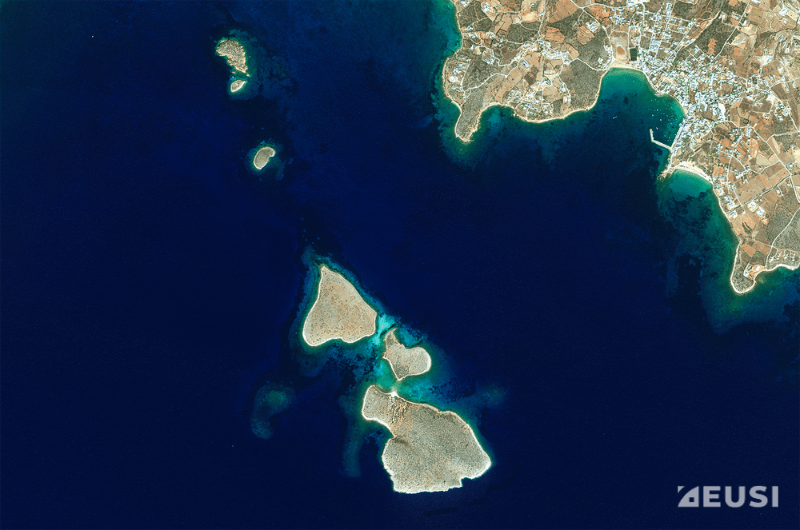
Satellites excel in accessing difficult regions such as borders, conflict zones, remote islands, and rugged geographies like mountain ranges. They offer unrestricted, non-intrusive and consistent data collection where aerial surveys may face logistical and safety challenges.
For example, we completed a mapping project of the whole area of Greece including its 6,000 islands and islets scattered in the Greek Seas. The entire area – 132,000 km2 – was covered in 1319 satellite images at 30–50 cm resolution.
Satellites can easily collect remote areas, including islands and islets or mountains. Satellite image © 2025 Maxar Technologies provided by European Space Imaging
7. Data processing
Satellite data is delivered in manageable file sizes thanks to efficient collection methods, reducing processing times to hours or days. Aerial imagery’s large, overlapping datasets require extensive time to process and even longer to mosaic.
Do you have questions?
Send us a message via the Contact Form – we are happy to help, answer your questions, or explain any technical parameters.
Related Stories

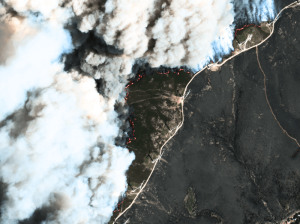
VHR Satellite Images Show Damage After Niscemi Landslide
In January 2026, Italy declared state of emergency after being hit by Cyclone Harry – a storm that brought 10-metre waves and torrential rains of over 300 mm in 48 hours. The most severely affected regions were Sicily, Calabria and Sardinia, with the damage in Sicily alone estimated to be more than 1.5 billion euros. EUSI collected Very High Resolution satellite imagery of the affected areas, including Niscemi – a Sicilian town hit by a massive landslide.
The Potential of WorldView Legion for the Safety and Security in Europe
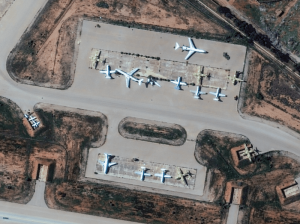
In the ever-evolving landscape of global security, satellite imagery has become an indispensable tool for governments, organisations, and businesses worldwide. Many of them are now learning about the new opportunities that the six recently launched Vantor WorldView Legion satellites bring: higher border security, improved maritime surveillance, faster reaction to developing events, and much more.

Beginner’s Guide to Satellite Imagery: 10 Terms You Need to Know
Satellite imagery is an amazing but highly technical field with terms that might be hard to understand, especially for somebody with expertise in a completely different area. That’s why we are explaining the basics of satellite imagery in this article. What’s geolocational accuracy? What is the ideal off nadir angle? How can you see through clouds? Let’s dive right in.

Europe’s Green and Digital Transformations with 25 Years of VHR Satellite Archive Data
Planning Europe’s future without knowing its past is impossible. The European Green Deal, Horizon Europe, the EU Biodiversity Strategy for 2030 and other policies all demand one thing: evidence. Not just today’s data, but years of history that show how our cities, forests, and coastlines have changed.