
Synchronised Collections of SAR and VHR Optical Satellite Imagery Revolutionise Flood Management
- Zuzana Hajkova, Content Marketing Coordinator, EUSI
As climate change accelerates, the frequency and severity of flooding events are becoming increasingly alarming. In response, innovative tools like DoubleShot, developed by European Space Imaging in partnership with Umbra, are transforming flood management strategies. By combining the power of Very High Resolution (VHR) Synthetic Aperture Radar (SAR) and Optical satellite imagery, DoubleShot delivers a comprehensive, weather-independent solution for near real-time flood mapping and monitoring.
The Rising Tide of Climate Change
Extreme precipitation, rising sea levels, higher river flow… These are all results of climate change, leading to an increased risk of flooding across Europe. According to the International Disaster Database, in 2023 alone, flooding affected 1.6 million people in Europe and caused around 81% of the year’s economic losses due to weather and climate-related events on the continent. Only a year later, heavy flooding in September 2024 caused multiple casualties and resulted in 25–65 years loss for insurers in Czechia, Poland and Austria. With many regions experiencing more frequent and intense flooding events, it is now more important than ever to invest in flood preparedness and response solutions.
SAR and Optical Satellite Images in Tandem
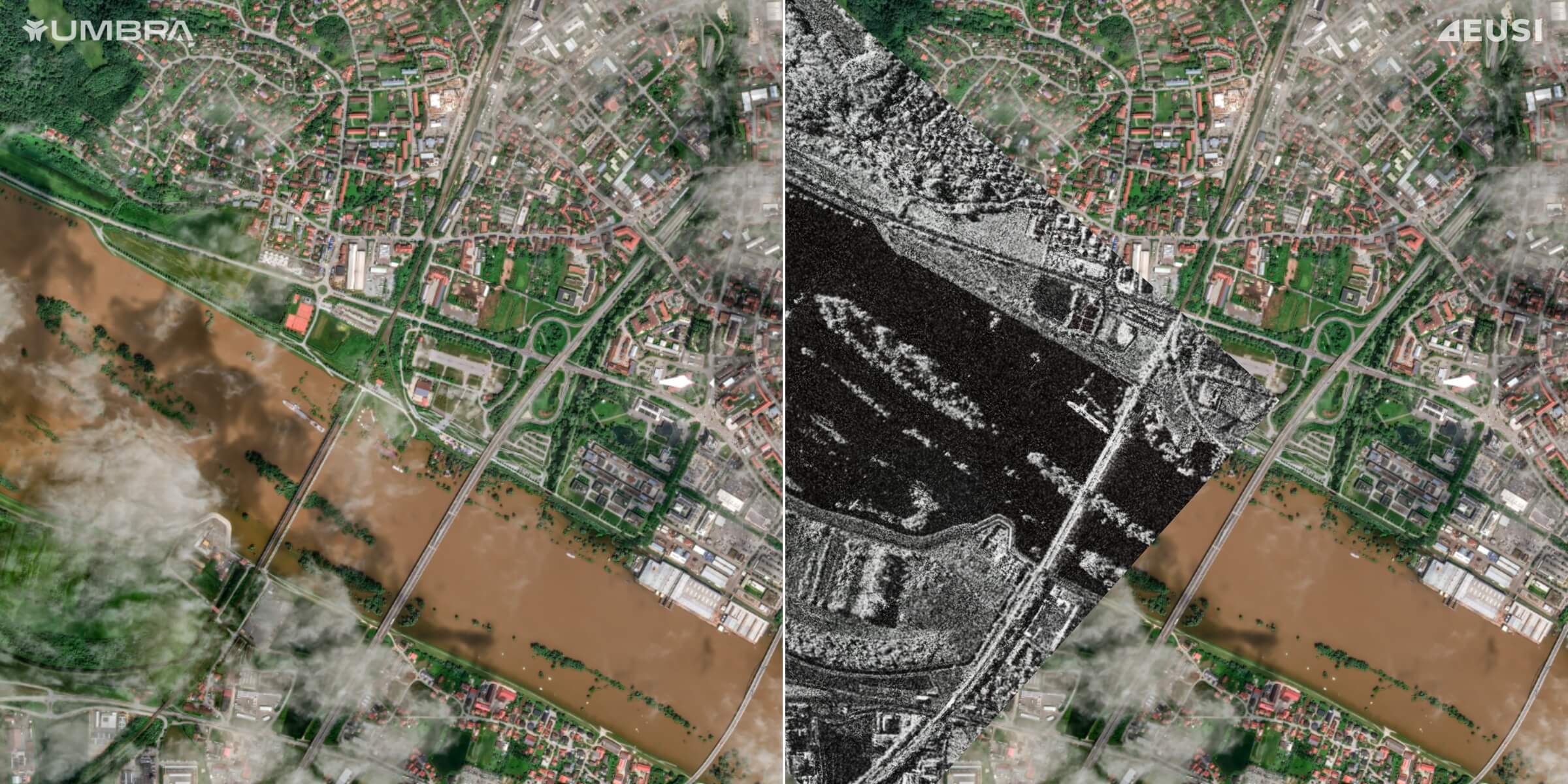
The most recent product available is DoubleShot – synchronised collections of 30 cm VHR Optical imagery and 25 cm SAR imagery. How does it work? The collection team at European Space Imaging (EUSI) analyses the orbits of Umbra (SAR) and Maxar WorldView (Optical) satellite constellations and matches collection times so that customers receive both optical and SAR imagery collected over their target area only a few minutes apart. This solution brings the benefits of both active and passive sensors, and combines them to provide maximum effectivity.
While VHR Optical imagery at 15 cm HD or 30–50 cm native resolution shows details like cars, people, road features or debris next to buildings, it is often obstructed by cloud cover during flood events. The missing data can be filled in from delivered SAR imagery.
Unlike passive (optical) sensors, which measure surface reflectance and are therefore dependent on sunlight and good weather conditions, active sensors used in SAR technology provide their own source of energy and then record the energy backscattered at the sensor. Thanks to that, SAR can provide insights regardless of cloud cover. This makes it the perfect complement to optical imagery in the case of flooding.
Optical satellite image © 2024 Maxar Technologies Provided by European Space Imaging | SAR image © 2024 Umbra Provided by European Space Imaging
Near Real-Time Monitoring: From Space to Action
For emergency situations, Near Real-Time delivery is possible: up to 15 minutes after collection for optical satellite imagery and up to one hour for SAR. Without losing precious time, relief organisations can rapidly answer questions such as:
- What is the extent of flooding?
- How many disaster responders are needed in each area?
- Which evacuation routes are currently obstructed?
- How many people need to be evacuated?
- What is the status of critical infrastructure?
- Is there a hazardous material spill that needs to be contained?
- Are there any disruptions to water supply systems?
- Were power lines damaged?
And many more.
Case Study: Floods in Southern Germany
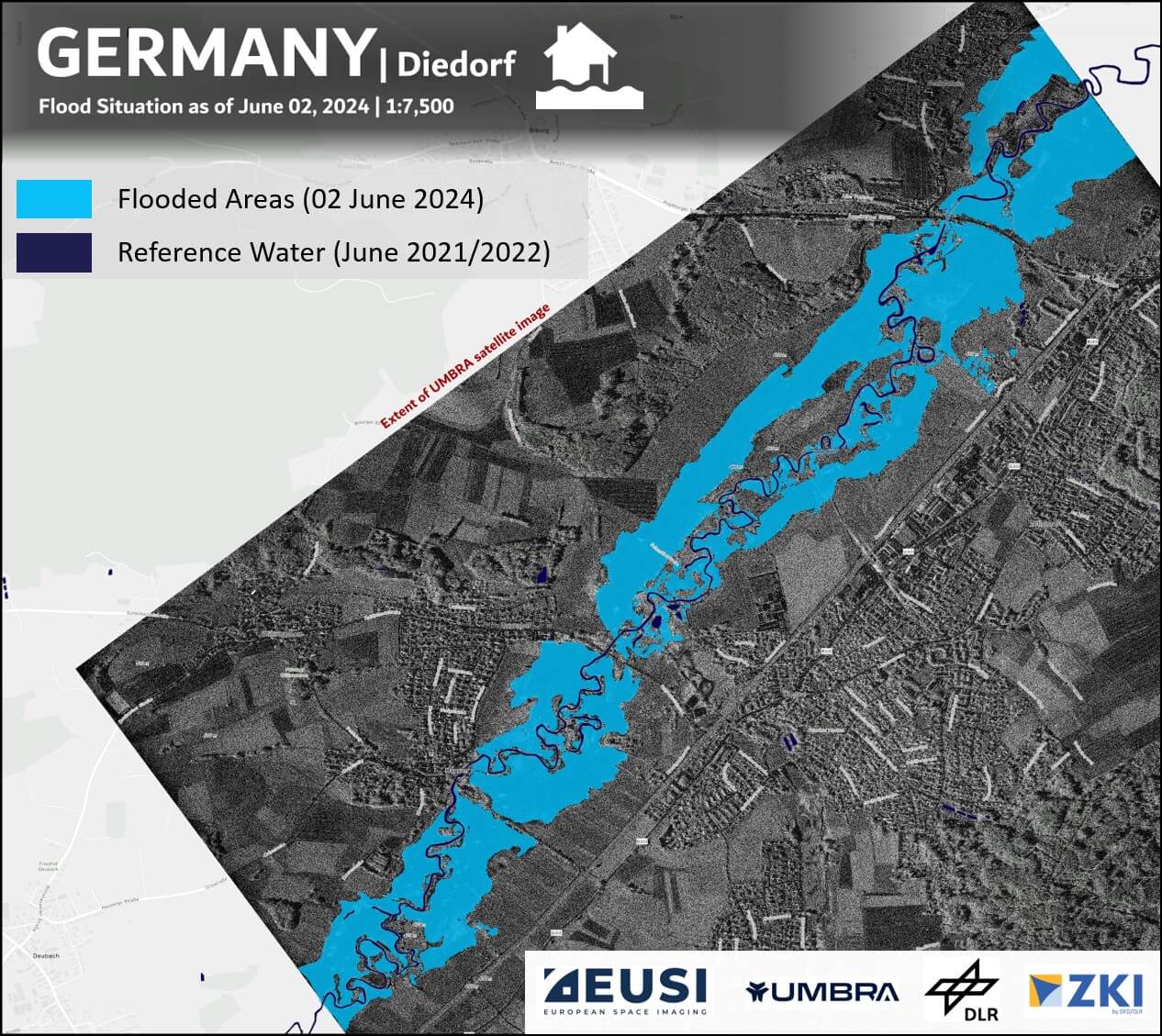
The combined tasking of very high resolution SAR and Optical imagery has already proven crucial in several emergency response and persistent monitoring applications. For example in June 2024, Southern Germany was hit by floods and due to persistent cloud cover following the event, no usable optical satellite imagery could be collected. EUSI therefore worked closely with the DLR-ZKI (Centre for Satellite Based Crisis Information at the German Aerospace Centre) to rapidly collect and deliver both optical and SAR satellite images of the flooding.
Analysts from the IFAS (Indicator Monitoring for Early Acquisition of Innovative Satellite Sensors in Natural Disasters) project received the imagery and created maps detailing flooded areas – thanks to the high resolution of the radar imagery, the flooded areas could be easily distinguished as the water had distinct reflections compared to surrounding dry land. The results were immediately made available to authorities and relief organisations such as the Bavarian Red Cross (BRK) and the German Federal Agency for Technical Relief (THW).
Map © DLR/ZKI 2024 | SAR image © 2024 Umbra provided by European Space Imaging
Empowering Regions Against Rising Waters
In the face of escalating climate change impacts, these innovative solutions are crucial for effective flood management. By merging very high-resolution SAR and Optical satellite imagery, DoubleShot offers rapid, weather-independent insights into flooding, enabling emergency responders to make informed decisions that save lives and property. Contact us to discover how DoubleShot can transform your flood management strategy.
Related Stories

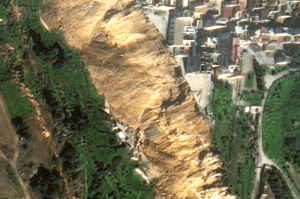
VHR Satellite Images Show Damage After Niscemi Landslide
In January 2026, Italy declared state of emergency after being hit by Cyclone Harry – a storm that brought 10-metre waves and torrential rains of over 300 mm in 48 hours. The most severely affected regions were Sicily, Calabria and Sardinia, with the damage in Sicily alone estimated to be more than 1.5 billion euros. EUSI collected Very High Resolution satellite imagery of the affected areas, including Niscemi – a Sicilian town hit by a massive landslide.

The Potential of WorldView Legion for the Safety and Security in Europe
In the ever-evolving landscape of global security, satellite imagery has become an indispensable tool for governments, organisations, and businesses worldwide. Many of them are now learning about the new opportunities that the six recently launched Vantor WorldView Legion satellites bring: higher border security, improved maritime surveillance, faster reaction to developing events, and much more.

Beginner’s Guide to Satellite Imagery: 10 Terms You Need to Know
Satellite imagery is an amazing but highly technical field with terms that might be hard to understand, especially for somebody with expertise in a completely different area. That’s why we are explaining the basics of satellite imagery in this article. What’s geolocational accuracy? What is the ideal off nadir angle? How can you see through clouds? Let’s dive right in.

Europe’s Green and Digital Transformations with 25 Years of VHR Satellite Archive Data
Planning Europe’s future without knowing its past is impossible. The European Green Deal, Horizon Europe, the EU Biodiversity Strategy for 2030 and other policies all demand one thing: evidence. Not just today’s data, but years of history that show how our cities, forests, and coastlines have changed.