TURKEY-GREECE BORDER: Satellite Images Show Refugee Crisis
- European Space Imaging
Thousands of refugees wait patiently in line at the Turkey border, as they await passage into Greece.
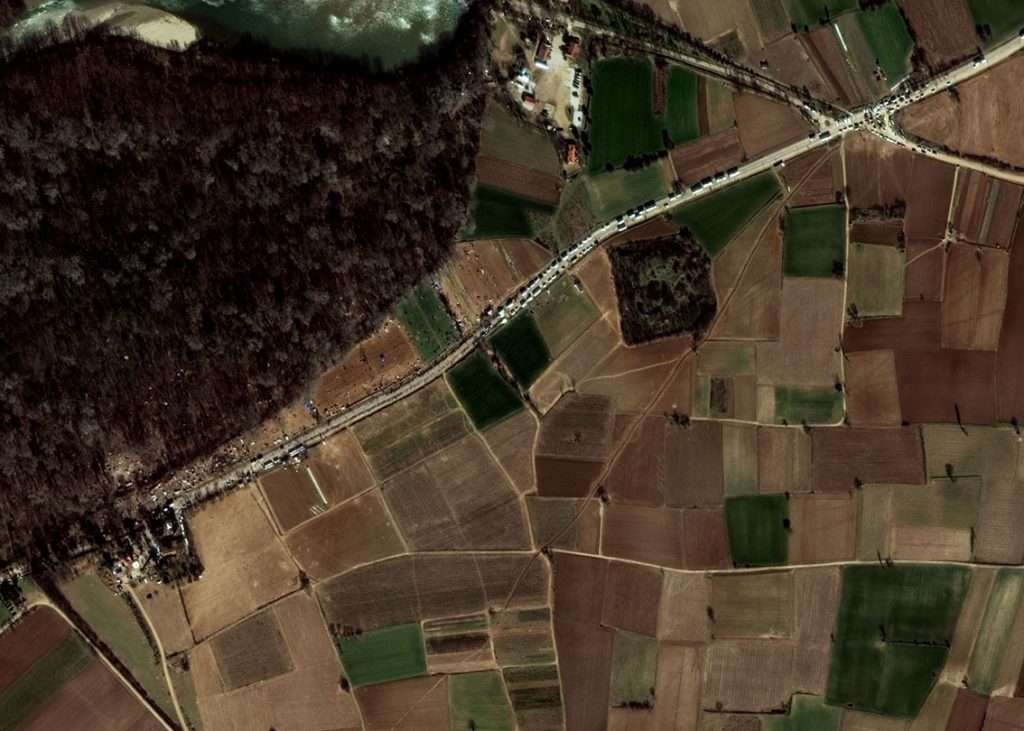
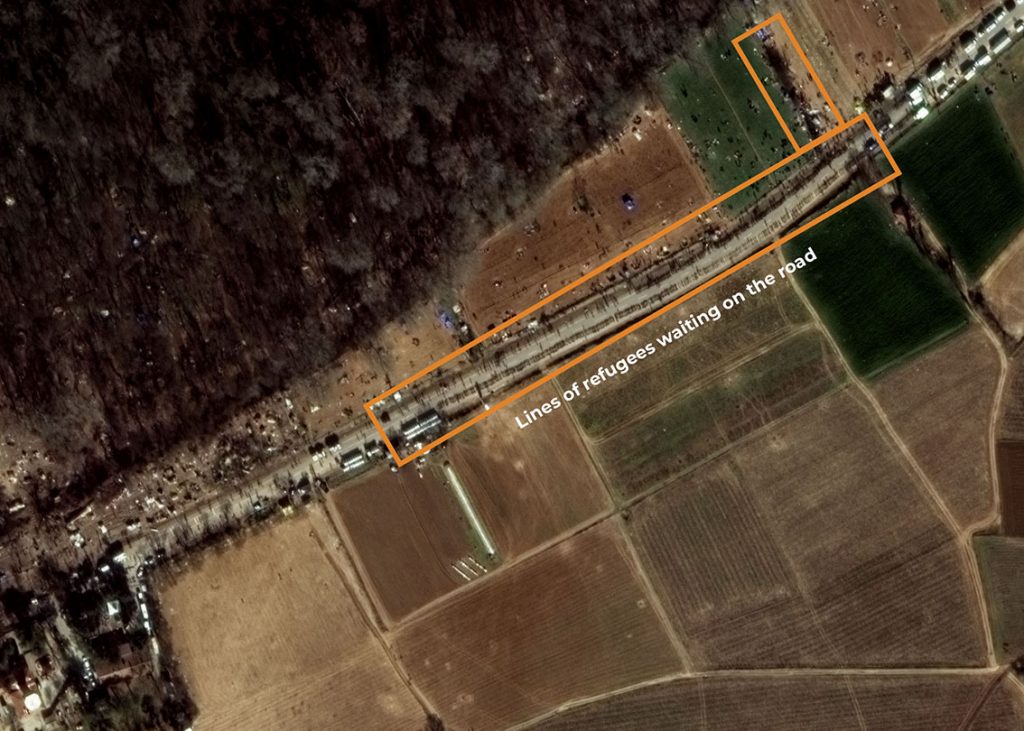
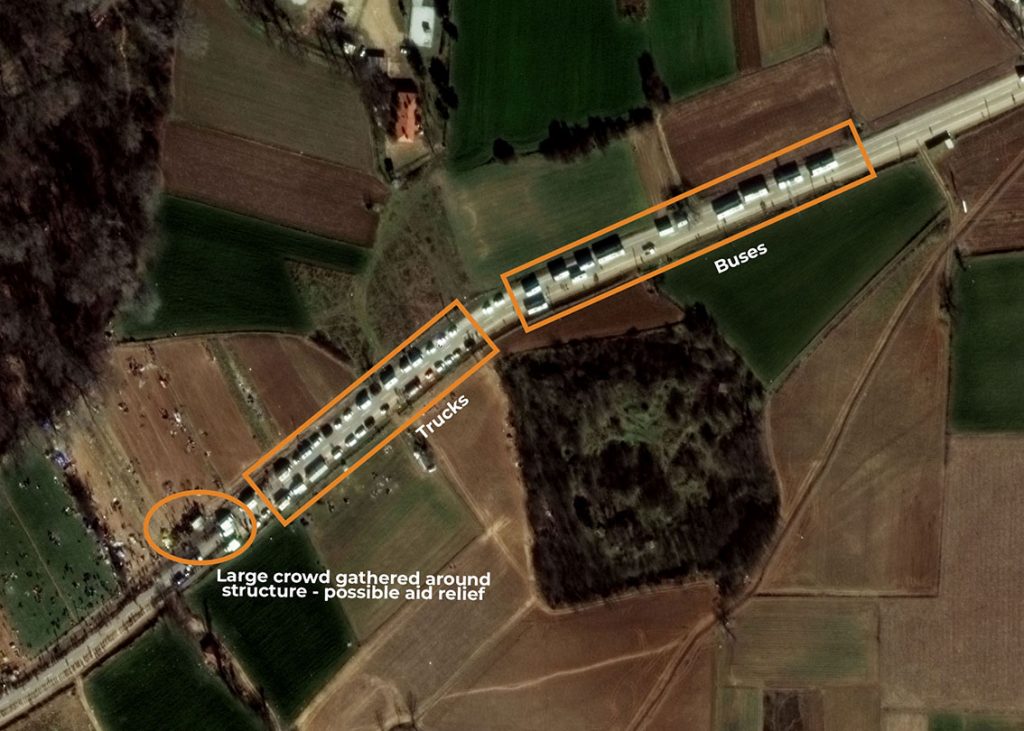
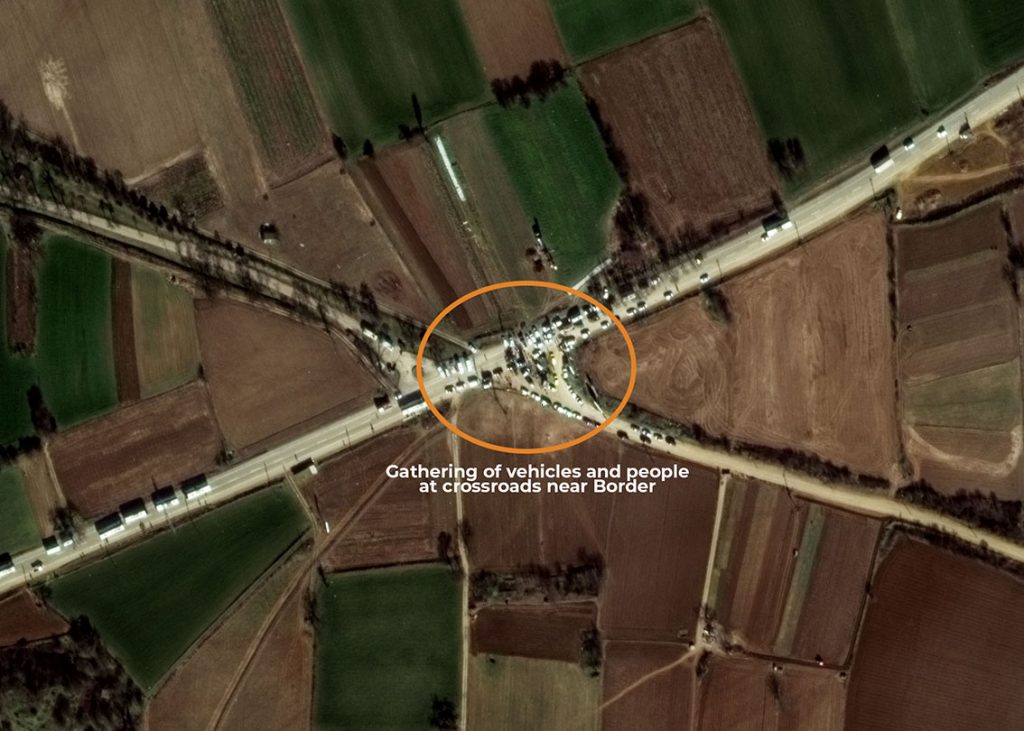
Satellite images captured early on 3 March, 2020 with WorldView-3 by European Space Imaging, show long lines of refugees on the road, numerous buses and trucks, as well as temporary housing facilities scattered adjacent to the road, extending well into the nearby forest.
Several buses on the road towards the border are clearly identifiable, correlating with reports that refugees are being bused to the area. In addition, numerous smaller vehicles with crowds of people surrounding can be seen. This could be indicative of aid support in the area. For security and safety, the border is being closely monitored by Frontex to mitigate any crises that could arise. “We are looking at other ways to help EU countries that border Turkey,” the agency said.
“Very High Resolution satellite imagery is both a cost-effective and time-efficient method of monitoring European borders as it allows identification of small objects in near real-time,” said Adrian Zevenbergen, Managing Director, European Space Imaging. “Country borders can run across long distances of differing terrain and people are small. Monitoring these areas frequently enables us to track refugee movements in order to ensure their safety.”
European Space Imaging will continue to monitor this situation and make images available as soon as possible.
Satellite image at 30 cm resolution showing overview of refugees, tents, trucks, buses and aid relief at the Turkey / Greece Border. Captured 03/03/2020 by WorldView-3 © European Space Imaging
Satellite image at 30 cm resolution showing lines of refugees on the road at the Turkey / Greece Border. Captured 03/03/2020 by WorldView-3 © European Space Imaging
Satellite image at 30 cm resolution showing buses, trucks and potential aid relief zone at the Turkey / Greece Border. Captured 03/03/2020 by WorldView-3 © European Space Imaging
Satellite image at 30 cm resolution showing potential aid relief zone set up at a crossroads near the Turkey / Greece Border. Captured 03/03/2020 by WorldView-3 © European Space Imaging
Related Stories

Beginner’s Guide to Satellite Imagery: 10 Terms You Need to Know
Satellite imagery is an amazing but highly technical field with terms that might be hard to understand, especially for somebody with expertise in a completely different area. That’s why we are explaining the basics of satellite imagery in this article. What’s geolocational accuracy? What is the ideal off nadir angle? How can you see through clouds? Let’s dive right in.

Europe’s Green and Digital Transformations with 25 Years of VHR Satellite Archive Data
Planning Europe’s future without knowing its past is impossible. The European Green Deal, Horizon Europe, the EU Biodiversity Strategy for 2030 and other policies all demand one thing: evidence. Not just today’s data, but years of history that show how our cities, forests, and coastlines have changed.

AI Uses 15 cm Satellite Images to Cut Costs and Increase Scalability in Forest Management and Urban Forestry
Forest managers across Europe face an impossible task: monitor millions of hectares with shrinking budgets while meeting increasingly strict EU environmental targets. But with the rise of AI and satellite technology, they now have new solutions at their disposal – smarter, cheaper, and more scalable – to monitor forest health, automate tree inventories, and plan sustainable logging. In this article, we introduce one of these solutions: an AI forestry algorithm developed by Arboair using 15 cm satellite data from EUSI.

GEOSeries: Extracting Insights From High Resolution SAR Imagery for Time-Sensitive Analysis
In this webinar, industry experts and advanced users of Umbra SAR data showcase how they transform SAR imagery into actionable insights in real-world mapping, monitoring and intelligence applications. See how NV5 and Umbra leverage ENVI SAR Essentials for advanced processing with time-efficient results, converting analytics into valuable intelligence.