Ecopia Global Feature Extraction (GFX) Powered by European Space Imaging
- European Space Imaging
European Space Imaging has recently signed a contract with Ecopia.AI, a trusted partner and global innovator in HD Vector Maps harnessing artificial intelligence and innovative cloud computing, to bring Ecopia Global Feature Extraction (GFX) Powered by European Space Imaging to customers worldwide.
This unique partnership between Ecopia.AI and European Space Imaging delivers an unparalleled competitive advantage of scale and accuracy. Incorporating fresh very high resolution satellite imagery collected by European Space Imaging, Ecopia leverage’s artificial intelligence based systems to rapidly extract vector maps at a continental-scale. This drastically reduces human effort and can generate and maintain millions of km2 of VHR Vector Maps for any area on the earth, all with the quality of a trained GIS professional.
“We are delighted to be able to service customers worldwide with this innovative product, offering an alternative to historically outdated vector map sources,” said Adrian Zevenbergen, Managing Director of European Space Imaging. “It is an exciting product that offers extensive time and cost savings to our customers and will allow us to significantly expand our geographic business operations”.
However, GFX offers much more than just building footprints. This powerful product can also identify land-based features from a highly-accurate, scalable, 12 class solution that provides contextual information regarding transportation networks. It performs the work of a dedicated GIS specialist in a fraction of the time, allowing your team to jump right into analyzing the data, thus making the product highly versatile and profitable across a broad spectrum of applications.
“Ecopia engages with market-leading data providers to form an ecosystem of partners that can empower the best solutions for our respective clients,” said Jon Lipinski, Co-Founder and President of Ecopia. “We are excited to be partnering with European Space Imaging as part of our effort to expand this global ecosystem.”
Related Stories

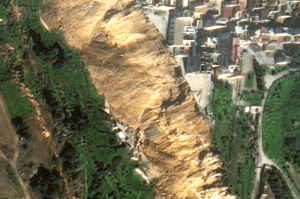
VHR Satellite Images Show Damage After Niscemi Landslide
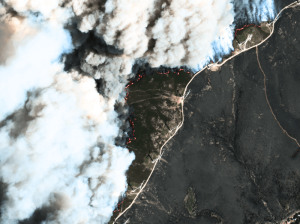
In January 2026, Italy declared state of emergency after being hit by Cyclone Harry – a storm that brought 10-metre waves and torrential rains of over 300 mm in 48 hours. The most severely affected regions were Sicily, Calabria and Sardinia, with the damage in Sicily alone estimated to be more than 1.5 billion euros. EUSI collected Very High Resolution satellite imagery of the affected areas, including Niscemi – a Sicilian town hit by a massive landslide.
The Potential of WorldView Legion for the Safety and Security in Europe
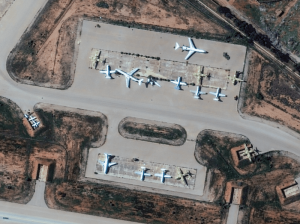
In the ever-evolving landscape of global security, satellite imagery has become an indispensable tool for governments, organisations, and businesses worldwide. Many of them are now learning about the new opportunities that the six recently launched Vantor WorldView Legion satellites bring: higher border security, improved maritime surveillance, faster reaction to developing events, and much more.

Beginner’s Guide to Satellite Imagery: 10 Terms You Need to Know
Satellite imagery is an amazing but highly technical field with terms that might be hard to understand, especially for somebody with expertise in a completely different area. That’s why we are explaining the basics of satellite imagery in this article. What’s geolocational accuracy? What is the ideal off nadir angle? How can you see through clouds? Let’s dive right in.

Europe’s Green and Digital Transformations with 25 Years of VHR Satellite Archive Data
Planning Europe’s future without knowing its past is impossible. The European Green Deal, Horizon Europe, the EU Biodiversity Strategy for 2030 and other policies all demand one thing: evidence. Not just today’s data, but years of history that show how our cities, forests, and coastlines have changed.