
European Space Imaging Partner in Newly Launched MARSAT Consortium

MARSAT consortium announced it is ready to provide innovative space-based applications using satellite-derived information for the maritime and coastal industry. MARSAT’s main goal is to create integrated satellite-based services to improve safety and efficiency in shipping, offshore industries, emergency response and rescue operations.

“MARSAT is an ambitious project, which brings together competence of specialists in satellite data provision and analysis, IT and the maritime industry. This team will lay the ground for improved decision making for shipping route optimization, offshore planning and maintenance as well as emergency events”, said Dr. Knut Hartmann, Project Coordinator MARSAT, EOMAP GmbH & Co KG

MARSAT is a consortium of six German companies, EOMAP GmbH & Co KG, Drift & Noise Polar Services GmbH, European Space Imaging GmbH, Institute of Shipping Economics and Logistics (ISL), SevenCs GmbH, TRENZ AG, and is funded by BMWi, the German Federal Ministry for Economic Affairs and Energy. The kick-off meeting was successfully held at the end of August 2016 at the German Aerospace Center (DLR) Space Administration in Bonn, Germany and marked the starting point of this 2.5 year project.

MARSAT – Satellite Services for the Maritime Industry

“The use of satellite data and Earth Observation products in the maritime world has an enormous potential. We are at the very beginning, just starting to get a glimpse at the possibilities and huge benefits these innovative technologies will offer.” Dr. Nils Meyer-Larsen, Project Manager, ISL

The technical goals of MARSAT are to create and integrate operational services to allow the maritime industry to take advantage of the most up-to-date satellite information in their day-to-day work. This requires setting up an efficient IT infrastructure to share, integrate and implement satellite-derived data quickly and efficiently from various satellite sources. Services such as ice detection and drift, obstruction and bathymetry mapping will be integrated in maritime information systems so that, e.g., shipping routes can be optimized, up-to date information made available for rescue or emergency events, and base data provided for environmental and coastal use cases within user friendly applications.

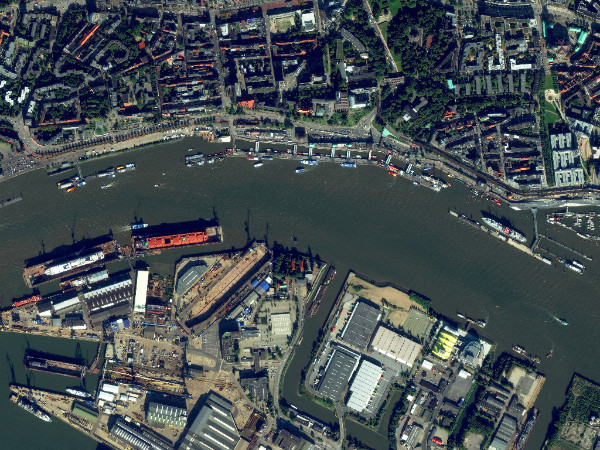
Port facilities in Hamburg, Germany imaged by WorldView-2, 3 Oct 2015.

“European Space Imaging believes in the potential of the Earth Observation industry to offer integrated, more user-friendly and sustainable services to the maritime industry. By uniting satellite-based information services into existing maritime information structures we will create better services and provide more safety in the industry,” says Adrian Zevenbergen, Managing Director, European Space, Imaging.

MARSAT is a dynamic and steadily growing network of data suppliers, users and academia, and cooperation is more than welcome.

Related Stories

Very high resolution satellite image showing military aircraft

The Potential of WorldView Legion for the Safety and Security in Europe

In the ever-evolving landscape of global security, satellite imagery has become an indispensable tool for governments, organisations, and businesses worldwide. Many of them are now learning about the new opportunities that the six recently launched Vantor WorldView Legion satellites bring: higher border security, improved maritime surveillance, faster reaction to developing events, and much more.

Read More »
Satellite image of a city at very high resolution

Beginner’s Guide to Satellite Imagery: 10 Terms You Need to Know

Satellite imagery is an amazing but highly technical field with terms that might be hard to understand, especially for somebody with expertise in a completely different area. That’s why we are explaining the basics of satellite imagery in this article. What’s geolocational accuracy? What is the ideal off nadir angle? How can you see through clouds? Let’s dive right in.

Read More »
AI in satellite based forest management

AI Uses 15 cm Satellite Images to Cut Costs and Increase Scalability in Forest Management and Urban Forestry

Forest managers across Europe face an impossible task: monitor millions of hectares with shrinking budgets while meeting increasingly strict EU environmental targets. But with the rise of AI and satellite technology, they now have new solutions at their disposal – smarter, cheaper, and more scalable – to monitor forest health, automate tree inventories, and plan sustainable logging. In this article, we introduce one of these solutions: an AI forestry algorithm developed by Arboair using 15 cm satellite data from EUSI.

Read More »