Ensuring Food, Farming, and Fairness

The Common Agricultural Policy (CAP) of the European Union is in place to ensure a fair standard of living for farmers through subsidies and other income support; provide a safe, stable and affordable food supply for consumers; and help balance development of rural areas throughout the continent. In Ireland, the Department of Agriculture, Food & Marine is responsible for the task of identifying parcels eligible for the program.

Detecting ineligible land features

Each year under the Single Payment System, farmers across the European Union are paid a subsidy based on the amount of land they actively farm. Land that has gone to scrub or where buildings or roadways have been put in place is considered ineligible. The Agriculture Ministry’s task is to identify those parcels where a change of use has taken place that no longer makes them eligible for subsidies under the
guidelines of the program.

“It is an ongoing and complex task that relies on a great deal of human intervention and interpretation,” explains Jason Parker, GIS technician for Dublin-based ICON, a European Space Imaging reseller. “The Ministry sought to develop a land parcel identification system database that could quickly and more automatically identify specific features of the landscape that do not qualify for payment under the program.”

Pilot program put in place

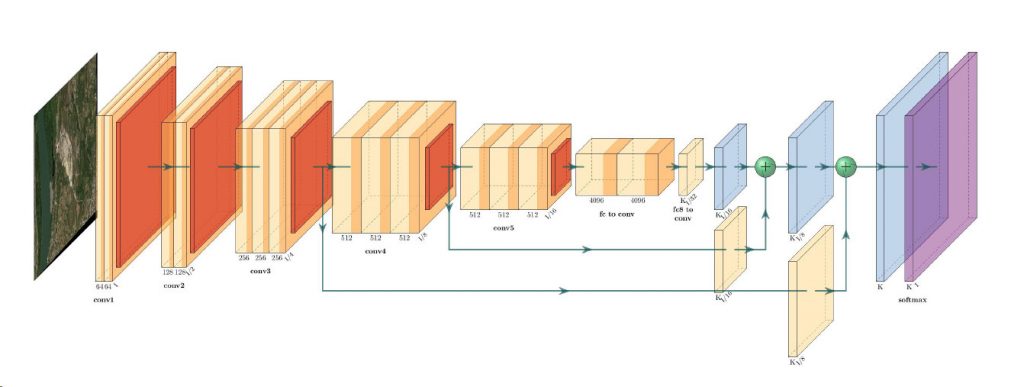
With the long-term goal of implementing a countrywide repeatable and consistent approach to imagery analysis and change detection, the Ministry asked ICON to develop a process that deployed an object-based image analysis scheme that would more fully automate the process, reducing the need for human interpretation and increasing both the accuracy and efficiency of the process. In March 2012, ICON embarked on a pilot project involving eleven 1.5 x 1.5 kilometer sites in the west of the country where the land is typically poor in agricultural quality with a lot of scrub. WorldView-2 was tasked with collecting the imagery.

“The objective of the pilot was to fully exploit the capabilities of the WorldView-2 eight-band dataset by extracting the most meaningful information from its remotely sensed data to speed imagery analysis and change detection,” Parker says.

Initial results indicate success

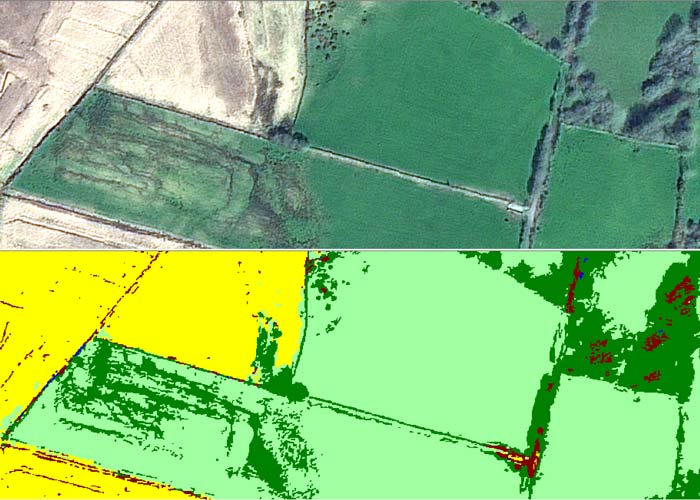
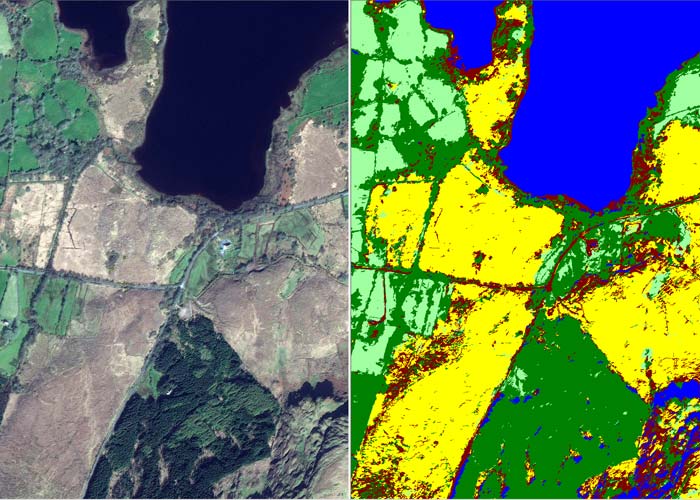
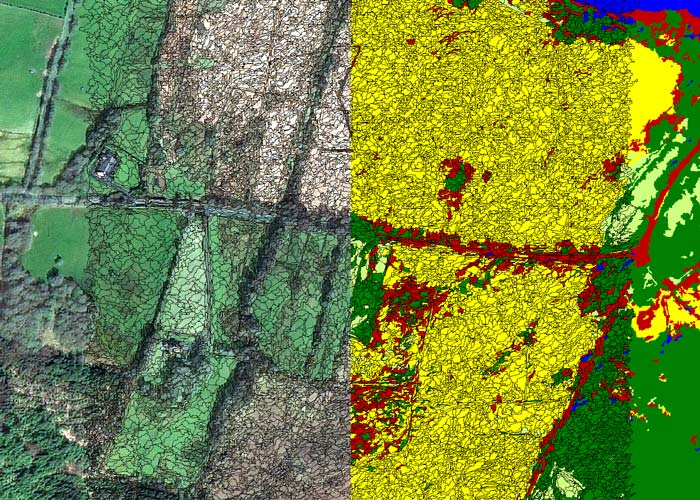
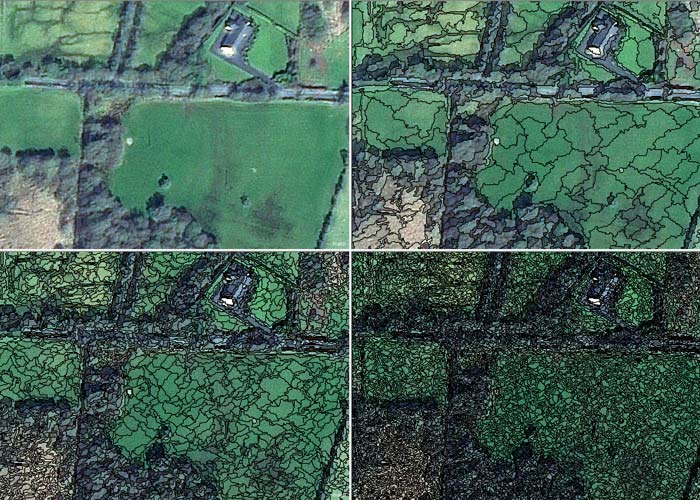
Once captured by WorldView-2, image objects, grouped by shape and texture, were created over four levels with each level having a finer segmentation than the level preceding it. Image classification is performed in three groups with each group using different features of color from the red, green, blue and nearinfrared bands, as well as various texture and vegetation indices.

“We basically used a bottom-up approach that essentially passes a series of filters over the image,” Parker explains. “The preliminary results indicated that the greatest accuracy comes from classification processes that utilize a combination of color and texture features that allow us to distinguish water, buildings and shadows.”

Creating a model of repeatability and consistency

Phase two of the project, incorporating even more data sources and upgrades and enhancements to the system’s analysis programs, are just getting underway. The end goal is to create a repeatable, consistent land parcel identification model that can be used in a variety of both rural and urban settings and adapted for use across the country and even the Continent.

"The first pilot project gave us great insight and direction to move forward and refine the model to cost-effectively create the consistent and repeatable system that can be applied to many environments, including urbanized areas where variables and rates of change are even greater, as well as to other countries across continental Europe."

Challenge

Create a cost-effective, consistent and repeatable methodology to identify land parcels where a change of use has taken place making them ineligible for EU government farm subsidies.

Solution

ICON deployed WorldView-2 high resolution satellite imagery across eleven 1.5 x 1.5 kilometer sites to demonstrate the technology’s ability to accurately extract ineligible land features.

Results

This broad-based solution not only speeds imagery analysis and change detection, but also creates a scalable, repeatable and consistent approach to the process.

ABOUT ICON

Established in 1994, Dublin-based ICON Group has a high level of expertise in handling data and information, and in building and re-engineering database systems. Continuously developing and updating its range of services, ICON has particular expertise in working with Irish data sets and has a strong grounding in dealing with spatial data.

Related Stories

Very High Resolution satellite image of the landslide in Niscemi, Italy

VHR Satellite Images Show Damage After Niscemi Landslide 

In January 2026, Italy declared state of emergency after being hit by Cyclone Harry – a storm that brought 10-metre waves and torrential rains of over 300 mm in 48 hours. The most severely affected regions were Sicily, Calabria and Sardinia, with the damage in Sicily alone estimated to be more than 1.5 billion euros. EUSI collected Very High Resolution satellite imagery of the affected areas, including Niscemi – a Sicilian town hit by a massive landslide.

Read More »
Very high resolution satellite image showing military aircraft

The Potential of WorldView Legion for the Safety and Security in Europe

In the ever-evolving landscape of global security, satellite imagery has become an indispensable tool for governments, organisations, and businesses worldwide. Many of them are now learning about the new opportunities that the six recently launched Vantor WorldView Legion satellites bring: higher border security, improved maritime surveillance, faster reaction to developing events, and much more.

Read More »
Satellite image of a city at very high resolution

Beginner’s Guide to Satellite Imagery: 10 Terms You Need to Know

Satellite imagery is an amazing but highly technical field with terms that might be hard to understand, especially for somebody with expertise in a completely different area. That’s why we are explaining the basics of satellite imagery in this article. What’s geolocational accuracy? What is the ideal off nadir angle? How can you see through clouds? Let’s dive right in.

Read More »