Satellite Imagery Brings Malawians Clean Water
- European Space Imaging
Malawi, located in southeast Africa, is one of the world’s most impoverished and least developed countries. Its capital city, Lilongwe, with a population nearing 800,000, has seen an influx of new residents as Malawians migrate from rural areas in search of economic opportunity. Many are settling in recently urbanized areas of the city that lack fresh drinking water.
People Lack Access to Clean Water
Access to clean water and sanitation are generally taken for granted in most of the developed world. According to the United Nations Development Program, one billion people lack access to safe drinking water in developing nations, including 300 million people in Africa. The toll is high. The World Health Organization reports that 2.2 million people die each year from a lack of potable water, nearly half of those are children.
Responding to the growing problem in Malawi, the European Investment Bank stepped in to finance a project to bring clean drinking water to the recently urbanized areas of Lilongwe where approximately 10 percent of the population lack access to clean water.
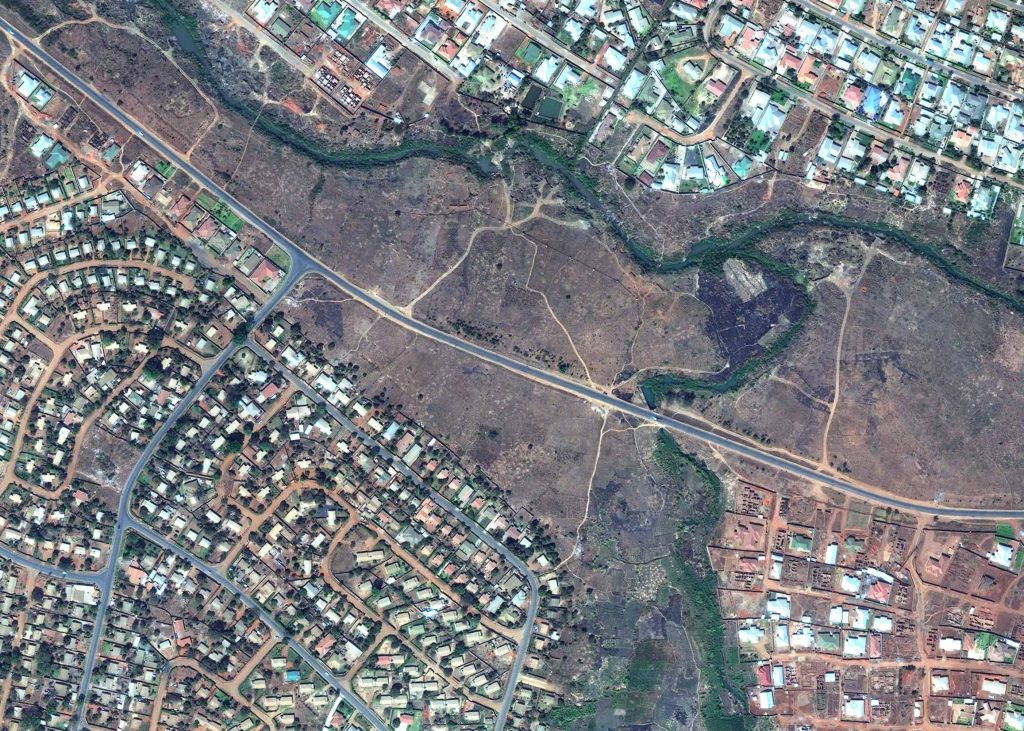
Very high resolution WorldView-2 imagery of Lilongwe made it easy to produce a base map, which can then be used to efficiently design the water pipeline network.
Alliance Partner Geoserve Tapped for Water Project
The first step in building the new water system was to identify those areas of the city that lack a drinking water supply. The European Investment Bank enlisted the expertise of Dutch water utility company Vitens Evides International to execute the project. WorldView Global Alliance reseller Geoserve was then tasked with creating an accurate and current base map of the entire city that was used to identify the areas in need of water.
“Given the incredible impact that fresh water will have on the quality of life in these areas, the ability to rapidly, accurately, and cost-effectively create the map is vital to the project’s success,” says Niek Schaap, Data Manager for Geoserve. “The high-resolution multi-spectral imagery produced by WorldView-2 proved to be the ideal match for this project.”
Because of WorldView-2’s enhanced feature classification and identification capabilities, particularly in bright and dark areas, its imagery is tailor-made for highly accurate mapping of individual buildings and other urban infrastructure. In addition, WorldView-2 is able to map large areas quickly and cost-effectively.
“The data captured by WorldView-2 is consistently current so we were able to create the base map in record time,” Schaap says. “Our client was very pleased with the project’s timing and the superior detail and accuracy of the base map. In the long run, this map will make constructing the water system faster and more cost efficient.”
A Model for Future Projects
With so many disparate areas around the globe lacking fresh water, the expedience of creating the Lilongwe base map can act as a model for both small- and large-scale projects similar in scope.
"The availability of accurate high-resolution satellite imagery can have a real impact on this global problem. When you think of the millions of people who lack access to fresh water, the ability to quickly and inexpensively create base maps from resources like satellite imagery and GIS analysis can have a huge impact on the lives of hundreds of thousands of people."
NIEK SCHAAP, Data Manager, Geoserve
Challenge
Create a base map of newly urbanized areas of Lilongwe to enable the European Investment Bank to bring fresh water to the approximately 80,000 residents who lack potable water.
Solution
Netherlands-based company Geoserve used WorldView-2 8-band very high-resolution satellite imagery to create a base map of the region, identifying areas lacking fresh water.
Results
A timely and cost-effective base map enabled the development of a plan that identified the most efficient design of the water pipe network.
ABOUT GEOSERVE
Netherlands-based Geoserve, a WorldView Global Alliance authorized reseller, specializes in the delivery of processed data, including maps, elevation data, and specific GIS data layers for a wide variety of industries and environments.
Related Stories

GEOSeries: Maintaining Temporal Control of Developing Situations With Rapid Satellite Tasking and Intraday Imaging
In the fast-moving operational environments of security monitoring and emergency response, the value of satellite data is defined by when it arrives, not just its resolution or accuracy. This webinar explores how Dynamic Tasking enables users to access actionable data fast and operate within mission decision windows.

VHR Satellite Images Show Damage After Niscemi Landslide
In January 2026, Italy declared state of emergency after being hit by Cyclone Harry – a storm that brought 10-metre waves and torrential rains of over 300 mm in 48 hours. The most severely affected regions were Sicily, Calabria and Sardinia, with the damage in Sicily alone estimated to be more than 1.5 billion euros. EUSI collected Very High Resolution satellite imagery of the affected areas, including Niscemi – a Sicilian town hit by a massive landslide.

The Potential of WorldView Legion for the Safety and Security in Europe
In the ever-evolving landscape of global security, satellite imagery has become an indispensable tool for governments, organisations, and businesses worldwide. Many of them are now learning about the new opportunities that the six recently launched Vantor WorldView Legion satellites bring: higher border security, improved maritime surveillance, faster reaction to developing events, and much more.

Beginner’s Guide to Satellite Imagery: 10 Terms You Need to Know
Satellite imagery is an amazing but highly technical field with terms that might be hard to understand, especially for somebody with expertise in a completely different area. That’s why we are explaining the basics of satellite imagery in this article. What’s geolocational accuracy? What is the ideal off nadir angle? How can you see through clouds? Let’s dive right in.